

Recently in Technology Category

You'll need a decent modern browser (Safari or Chrome) to see this:
http://bartaz.github.com/impress.js/#/overview
Enjoy!
Sites we love
- Casinos Not On Gamstop
- Non Gamstop Casinos
- Casinos Not On Gamstop
- UK Betting Sites
- Casino Sites Not On Gamstop
- Best Non Gamstop Casinos UK 2025
- Non Gamstop Casino UK
- Best Non Gamstop Casinos
- Non Gamstop Casinos UK
- Non Gamstop Casinos
- Casino Sites Not Blocked By Gamstop
- Non Gamstop Casinos UK
- Casino Not On Gamstop
- Non Gamstop Casinos
- Slot Sites UK
- Non Gamstop Casino Sites UK
- Casino Sites UK Not On Gamstop
- UK Casinos Not On Gamstop
- Non Gamstop Casino
- UK Online Casinos Not On Gamstop
- New Non Gamstop Casinos Uk
- UK Casino Not On Gamstop


No Comments
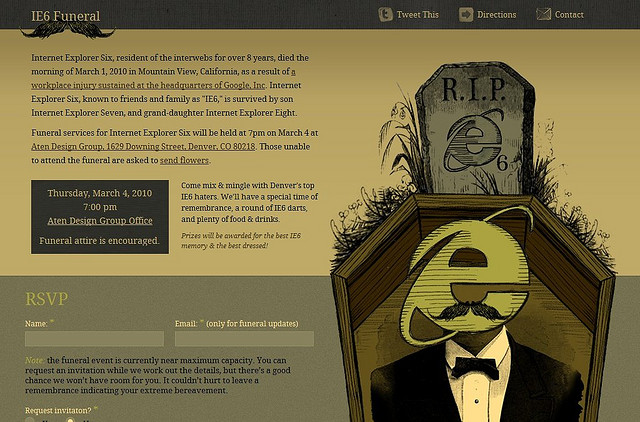 Image from Majento
As a business, you’re going to want a really nice looking website, right? All the ease of use/navigation and a nice slick interface filled with animation and effects. Of course you do. We all do.
Forget your budget for a second and let’s say you get that site. The creative juices start flowing and the possibilities are almost endless. It’s going to be the best site ever. Finally it’s completed and you couldn’t be happier with the results. It shows just how cutting edge your business is. You might even say a cut above the rest. Excitedly, you go to show your decision-maker what he/she has paid for and-BAM-it looks awful. The formatting is ruined, the effects don’t work and subsequently, you cannot even navigate around.
How can this be? It looked GREAT on your machine. Then the penny drops - they’re viewing in Internet Explorer 6. So are most of your colleagues. So are many of your customers. You go back and have the site amended so it is compatible with IE6. Everything needs to be simplified, possibly even working from the ground up, and suddenly your site looks no better than that of your competitors…
But why is IE6 such a big issue for websites, and what can you do about it?
Wow - if you want a really poor user experience try using the Blackberry App store for the first time.
I have 2 phones, and iPhone for home and a Blackberry we use as a work support hotline. I decided today to check out the blackberry app store.
Now, you'd have though that Blackberry, being a little late on the app scene, would be trying hard to make their app store as successful as possible. I'm left feeling they actually don't want anyone to use it at all.
First up, no instructions for first time users.
Second, lots of messages about my OS being unsupported (*of course* i'm on a mac).
Third, when you click sign in you this:
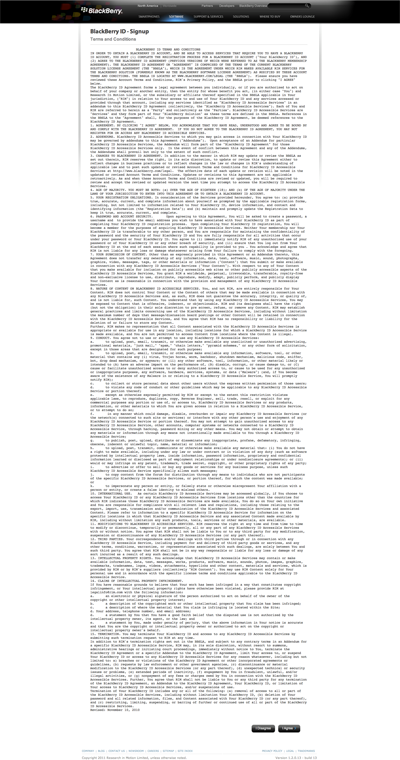
Offputting or what?
I persevered (wondering if I've just signed away a kidney or something), then I was asked for both a ScreenName and a UserName - what's the difference? How many names do i need?It turned out my screen name needed to be a valid email address. So I entered one. Then it said it was invalid. It wasn't.
I gave up.
A client of ours has a large salesforce using Blackberrys. We are considering whether an App could be useful for them... but after this experience I wonder if anyone would even be able to download it in the first place?
Come on people at Blackberry, do you actually sign up yourselves? Has anyone noticed this mess?
No Comments
Flash had a bit of a hard time in 2010, and many will point the finger at Apple. When the iPad was released, consumers complained Flash didn't appear on the device, like its iOS sisters: the iPhone and iPod touch. Steve Jobs' Thoughts on Flash open letter cleverly spins the argument for not supporting the tech as a 'feature' as opposed to a 'hindrance'... in a "this is for your own good", kinda way.
They have now taken this one step further by shipping all new Macs without Flash pre-installed for Mac OS X - which started with the MacBook Air and now on all new Macs. Apple claim this is because users will not receive the latest version on initial install, and so have given them the "choice" to install Flash themselves, making it less, "Flash! Ahhhh!" and more, "Flash! Arrggh!"
Apple-cynics will argue that Jobs is dictating what technology us consumers are and are not 'allowed' to use. But cynic or evangelist, one would be forgiven for thinking Apple is trying to flush the technology completely. It raises many questions regarding the future of Adobe's adopted baby, and whether it is indeed obsolete...


These days web users are savvier than ever. Chances are that when you're surfing, you'll ignore banners and other online advertising so much that you hadn't even realised what they were trying to communicate - or possibly that they were even there. This, of course, makes the role of the online advertiser a lot more challenging.
Interactive banners are an attempt to stop this happening and catch the user's attention. They're capable of expanding, containing input fields or even interacting with the content within the page. And they're becoming more and more elaborate as their capabilities extend much further than an animated gif within a letterbox banner.
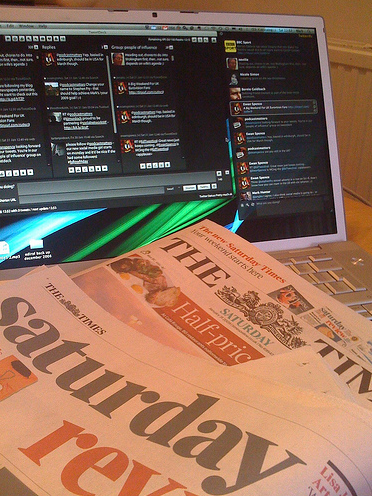
A while ago I wrote a blog post about the effect Twitter has had on news reporting. In this blog I said that Twitter had increased the speed of information transfer so much that online news services that were once seen as the speedier upgrades to newspaper reporting had now become the slower alternative to Twitter.
Yesterday, the day that England football team manager Fabio Capello named his squad of 23 players, summed up my sentiments perfectly.
Capello was due to tell seven players who had been training with the provisional, 30-man squad that they would no longer be needed. All the news agencies and broadcasting companies were expecting a low-key FA statement, probably on their website, that would list exactly who would be on the plane. It was predicted to be a very stark contrast to the all-singing, all-dancing, overblown news conference that previous manager Sven Goran Eriksson delivered for the World Cup in Germany, four years previously.
What we got was neither, really.
Instead, we were drip-fed player names from journalists, player agents and their clubs telling us whether their players had made the cut or not. And Twitter was the primary means of communication.
Matt Law of the Daily Express was one of the first to break the news of Theo Walcott’s shock omission. “Walcott out of England World Cup squad,” he tweeted. “Gutted for him.”
Then Neil Ashton of the News Of The World told us that Michael Carrick, Shaun Wright-Phillips and Jermaine Defoe had made the cut. “Relief for Carrick, he’s in the England squad,” he tweeted. “Shaun Wright-Phillips in squad, Defoe in too.”
In the Sky Sports News TV studio, it seemed as if the reporters had given up trying to contact the FA for the latest news, or, at the very least, continuously hitting the F5 button on the FA homepage. Instead, it seemed as if they were now using their Twitter network to find out from players or people close to the players whether they were going or not.
It wasn’t until 4pm that we were all finally put out of our misery and an official announcement was made. But by this time we pretty much knew all seven names of those who wouldn’t be on the plane to South Africa - it was old news.
The FA certainly didn’t do themselves any favours by acting so slowly and perhaps it was naïve of them to assume that they could be so unprepared and get away with it. The longer they delayed the official announcement, the greater the chance that leaks would surface.
The fact is that online communications platforms like Twitter have completely changed the landscape of mass communication. Like it or not, any unofficial, transient word spoken intended to be disclosed information can be made public knowledge within a matter of seconds, with just one tweet. In this digital age, large organisations with public relations at the top of their agenda need to ensure they can adapt - and fast. And making sure they understand the way that digital communications platforms like Twitter work is fundamental to their success in doing so.
Spring is (supposedly) here and, if you’re anything like me, you’ll be fantasising about all the things you can do outside, just as soon as the weather becomes bearable and we’re treated to lighter and longer days. Right now I’m thinking about the joys of cycling around Richmond Park in the sunshine followed by a nice pub lunch and a cold beer. I’m so excited about it that I’m thinking about getting myself a new bike for the summer.
I’m not one to impulse buy. For me, part of the excitement of buying something of any great expense (I’ll be riding it to work every day, so I intend to get one that will last) is reading up about it, speaking to a couple of ‘experts’ and trying to hunt down the best price. I may spend days - weeks, perhaps - working out which one I’ll buy and how to get the best deal. I’ll visit retailers, go Google shopping and hunt around for any sales.
I’m sad, I know, but me admitting that is not the point of this blog.
Days after trawling through cycle shops’ websites, hunting for the ideal bike, I was minding my own business on a non-bike-related site when a banner ad caught my eye. Nothing unusual about that, you’ll say, but this particular banner ad was about the very bike I had my beady little eye on while ‘on the hunt’ - the bike at the top of my shortlist. Coincidence, I thought. But then this happened on another site. And another. I started to think I was going a little crazy…
After speaking with the web geniuses in the project management team at Base One, I realise that I wasn’t crazy (or, if I am, that it was unrelated). It was in fact a clever targeted banner that stored what I had been looking at in a cookie. It could then find me wherever I went in the future. A stalking banner, if you will. Very clever, huh? Well, is it? Or is it just creepy?
Then something similar happened. I was also looking for a cookery book on Amazon later that week. Lo and behold, I get an email a day or two later with a few alternative suggestions for cookery books I should consider.
In this instance, I wasn’t as spooked because Amazon has used a cookie to store your search history for as long as I can remember using the site. (I know this because I get recommended some lovely Cath Kidston kitchenware and kitchen wear each time I visit just because I bought some for my mum one Christmas.)
But, for me, there is a line that can be crossed between clever marketing and an invasion of privacy. That banner ad was like a little voice in my head that seemingly said, “Go on, buy me. Go on! Buy me. You know you will eventually because you’re weak.” Did it cross the line? To be honest, I’m not sure. Yes, I realise I can turn cookies off on my browser to stop this happening again, but I suppose my biggest worry is where it’s heading…
I remember a university lecturer telling us all that sooner rather than later the GPS feature found in many mobile phones would soon be used to advertise ads for a certain product or store as you walked past them in the street. Imagine walking past a KFC and your phone flashing an ad for their latest Mega Chicken Twister Tower Wrap thingy - I’d be huge within a year. At the time, I thought this lecturer was a little bonkers. Now I’m not so sure. After all, something not too dissimilar may already happen if you turn on your phone’s Bluetooth.
If this were to come true then surely the line between clever marketing and invasion of privacy has been crossed? When does an ad become a message that you can selectively filter and when does it become obtrusive and annoying? I’m afraid I’m too busy to tell you - I’ve got to go buy that bike.

You see these guys all the time in town [that's London, UK, for overseas readers]. I couldn't resist chatting to one the other day, to ask just what kind of ads I would get if I switched my Bluetooth on.
He took one look at my phone and shook his head. "Nahh mate. Doesn't work on iPhones."
So that's more than 50% of the market lost before they start. Nice idea, but without iPhone it's not really going anywhere, is it?
No Comments
The Big Switch is a good read for the non-techie who wants to understand the essentials of cloud computing and its societal and marketing implications. At least, that's why I picked it up (thanks, Tom). But it was also an engaging vision of how the 'World Wide Computer' is changing life at every level.
Nicholas Carr delivers this easy-reading gloss of the digital 'switch' within a historical context that effectively tones down the usual hyperbole about revolutionary tech change. He takes us back to Edison and the invention of the electricity grid to ease us into the idea that technology is changing the way we work, consume, socialise and even think - again.
This context does make that idea oddly more palatable: in a way, we've already allowed technology to do this to us on a slower, perhaps less invasive scale, and it's been (shrug) ok, even good for us. He is careful to note the differences in the difficulties and benefits that accrue from each of these paradigm shifts, though.
I think what I appreciated most about this book compared to hyped-up accounts of how the www. is changing human interaction and commerce is that Carr isn't handing us a pet theory decorated with punditry - he's grounding the facts, analysis and opinion about a tech phenomenon in history and giving it all a sense of relevance instead of (merely) spin. The result for me is a feeling of having learned something instead of being sold it.
This is just one of the many staggering statistics that have been published recently by Facebook as it celebrates its latest user milestone.
Others amazing stats include the fact that 23m people in the UK are registered Facebook users, and that 50% of UK those users visit daily, with an average time of 55 minutes spent per day on Facebook.
Now maybe my maths is a little suspect, but I think this means that around 10 million hours per day are spent on Facebook. Assuming the average working day is 8 hours, that is around 1.2 million working days. The working population is 33 million, so I amateurishly conclude that for every hour the average UK worker spends working, they also spend about three minutes checking for updates on Facebook. Incredible.
